
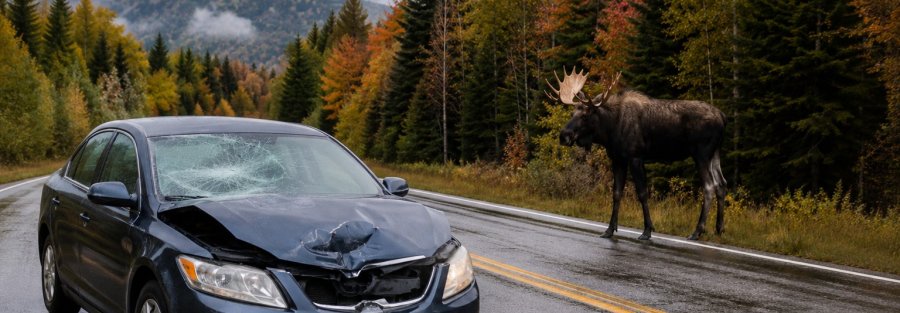
I still get the same phone call every fall, usually right around dusk, usually with a shaky voice on the other end: “Renee, I think I just hit a deer.” Sometimes it’s a deer. Up here in Vermont, sometimes it’s a moose, and let me tell you, a moose is not a “whoops, minor fender bender” animal. A moose is a 900-pound argument you are going to lose.
So let’s settle this once and for all, because I explain it about six times a week between October and December: hitting a deer or a moose is not a collision claim. I know, I know — it feels like a collision. Your car collided with a large mammal at 45 miles an hour. But in insurance-speak, “collision coverage” only applies when you hit another car or a stationary object, like a mailbox, a guardrail, or — ask me how I know — a very determined snowbank. Animals fall under comprehensive coverage, the part of your policy that handles the stuff that just happens to you: theft, fire, flying rocks, hailstorms, and yes, wildlife with a death wish and no concept of headlights.
Why deer and moose are Vermont’s own special insurance headache
We’re not West Virginia (they hold the dubious honor of the highest odds of an animal strike in the country), but Vermont drivers know the drill. Dirt roads cutting through farmland, dusk commutes on Route 7, mud season turning every shoulder into a deer buffet — we’ve got the ingredients. Nationally, drivers file somewhere around 1.7 million animal-collision claims a year, and the busiest stretch runs from October through December, when deer are on the move. That lines up exactly with when my phone starts ringing off the hook.
Moose add their own flavor of chaos. A deer strike usually means a smashed bumper and a very sad grille. A moose strike means the animal’s body is roughly at windshield height, because their legs are so long the impact tends to come in high rather than low. It’s a different kind of accident entirely, and it’s exactly why I sit down with every single Vermont client — new drivers, longtime customers, my own grandkids when they finally get their licenses — and ask the same question: “Do you actually have comprehensive coverage, or did somebody talk you into dropping it to save twelve bucks a month?”
The mistake I see constantly
Here’s the thing that keeps me up at night, or at least keeps me typing angry follow-up emails: liability-only policies do not cover animal strikes. Full stop. If you’re driving an older car and you decided comprehensive wasn’t worth the premium, an encounter with a deer means you’re paying for that repair — or that replacement — entirely out of pocket. I’ve watched people cry actual tears over a totaled Subaru and a $6,000 repair estimate because nobody ever explained the difference to them. That’s not going to happen to my clients if I can help it. When someone walks into our Milton office, I don’t just sell a policy and shake hands. I walk through what you drive, where you drive it, and whether a wildlife encounter would wreck your finances or just your Tuesday. That’s the whole philosophy behind how we build out an auto insurance policy that’s actually shaped around Vermont driving conditions, not some generic template built for a driver in Phoenix who’s never seen a moose in his life.
What I tell people to actually do
If you do hit one, here’s my short version of the speech I give over the phone at 6 p.m. on a Tuesday: get your car off the road if you safely can, put your hazards on, and do not go poke the animal. A wounded deer or moose is unpredictable and can absolutely still hurt you. Call the local police or state troopers, especially if the animal is blocking the road or you’re not sure your car is drivable. Take photos. Then call us — or your carrier — before you do anything to the vehicle. I’ve had clients try to “just get it looked at real quick” at a shop before filing, and it makes the claims process messier than it needs to be.
And please, for the love of all things holy, don’t swerve to avoid the deer. I say this every single autumn and I’ll say it again: braking firmly and staying in your lane is safer than yanking the wheel and putting yourself into oncoming traffic or a tree. That’s not folk wisdom, that’s straight from the highway safety researchers who study this stuff for a living, and the data backs it up — a huge share of the serious injuries and fatalities in animal-related crashes happen when drivers swerve, not from the initial impact itself, according to the Insurance Institute for Highway Safety.
Why I actually enjoy this part of the job
People sometimes ask why an insurance agency owner gets this animated about wildlife collisions. Honestly? I grew up around horses. I still ride and train them, and I’ve spent my whole life around large animals that can go from calm to chaos in half a second. I get it. I’m not lecturing anybody from behind a desk who’s never had a close call with something four-legged and 200 pounds heavier than they’d like. When my agent Shawn — who spent a decade with Allstate before coming back to our team — talks through how comprehensive coverage handles an animal strike, he’s not reading off a script. He grew up on a dairy farm. Between the two of us and the rest of our crew, this agency has seen just about every version of “an animal ruined my Tuesday” that Vermont has to offer.
My professional advice
If you drive anywhere near a tree line, a farm field, or basically anywhere in this state that isn’t downtown Burlington at noon, comprehensive coverage isn’t optional peace of mind — it’s just common sense. According to the Insurance Information Institute, the average animal-strike claim runs into the thousands of dollars once modern sensors, cameras, and bumper components get involved, and that number keeps climbing as cars get more expensive to fix. I’d rather sit down with you now, over coffee or on the phone, and make sure your policy actually matches how you live and drive, than have that awkward “I wish we’d talked sooner” conversation after your car is already at the body shop.
So give us a call at the office, or stop by 684 W. Milton Rd. We’ve been doing this since my dad started the agency back in 1965, and this is exactly the kind of conversation we still like having — even if it means explaining, for the thousandth time, why hitting a moose isn’t technically a “collision.” Let’s get your Vermont auto insurance coverage squared away before deer season sneaks up on you again, and while we’re at it, I’ll walk you through the rest of your car insurance policy to make sure nothing else is quietly underinsured either.